

The European Century · Newsletter · Issue No. 3
Hello,
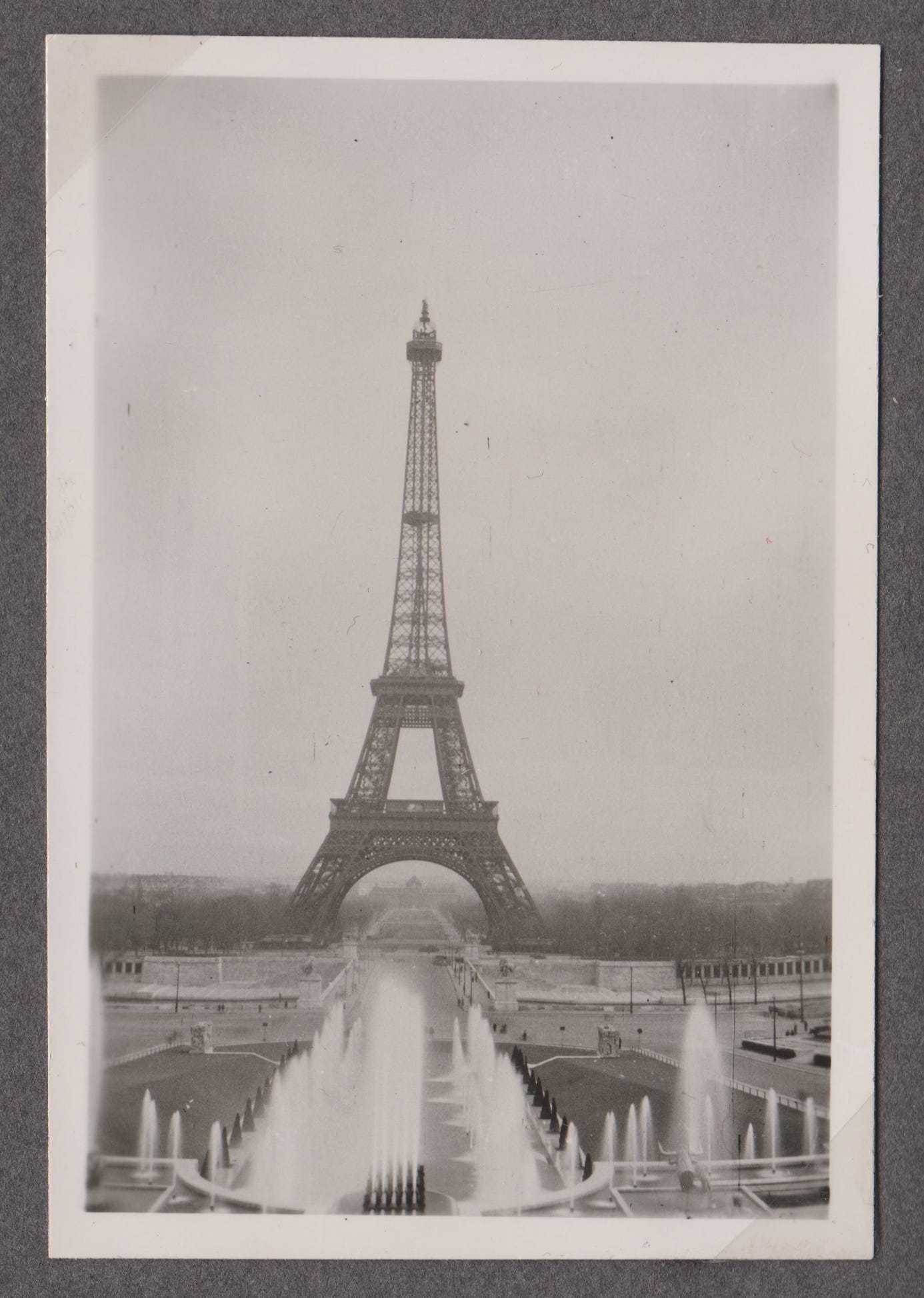
I have been living in occupied Paris for several weeks now.
Figuratively speaking, of course.
I am writing this newsletter as I sit in the southeastern part of the United States, in the summer of 2026, eighty-two years after the actual events took place. But writing in-depth narrative history requires the particular amount of mental immersion in the chosen time and place. You begin to carry the decade with you. The war-battered streets of 1940s Paris are just as vivid to me right now as the peaceful suburban street outside my front door.
One of the things that makes this particular decade so absorbing to research — and so challenging to write — is its moral complexity. The Berlin 1920s portrait, which I hope many of you have read, was a story about a city that made extraordinary things and then watched them be taken away. Paris in the 1940s, however, is different. It is a story about what ordinary people do under extraordinary pressure — and the answer, as history always reveals when you look closely enough, is: complicated things. Neither heroic nor shameful in any simple sense. Human things, in the fullest and most uncomfortable meaning of that word.
What I am reading
I rarely write about a historical period without also reading the fiction that has tried to represent it. It isn’t because fiction is a reliable historical source, but because the best historical novelists do something that academic history cannot quite do: they make you feel what it was like to be inside the events rather than above them.
I recently finished The Paris Library by Janet Skeslien Charles, and it proved a genuinely illuminating companion to the research. The novel tells the story of the American Library in Paris during the Nazi occupation — a true story at its core, highlighting courage and the importance of keeping intellectual curiosity alive. What struck me most about it was the angle it finds on the occupation: the librarians who defied the Nazi authorities by delivering books to Jewish readers after they were forbidden from entering the library. This is the occupation viewed not through the lens of armed resistance or political collaboration but through the quieter, equally dangerous act of insisting that people have the right to read. It is an angle the history books rarely take, and it is one that illuminates the decade in ways that the political narrative cannot.
The novel’s librarian protagonist, Odile, faces exactly the kind of impossible choices that I am trying to write about in the Decade Portrait — when the war finally ends, instead of freedom, she tastes the bitter sting of unspeakable betrayal. That line captures something essential about the occupation’s aftermath: that liberation did not resolve the moral questions the occupation had raised. It only made them more visible.
I have now moved on to The Last Time I Saw Paris by Lynn Sheene — the story of a young American woman who arrives in Paris in May 1940 with a romantic vision of starting anew and finds herself caught up in the German occupation, eventually working with the French Resistance. I am particularly interested in Sheene’s use of the outsider perspective — the American eye encountering occupied Paris — because it mirrors the angle I find myself taking as I write about the decade from the other side of the Atlantic. We are all, in some sense, outsiders to this history. The question is whether we look closely enough to see past the surface.
And behind both of these sits Suite Française by Irène Némirovsky, which I read some time ago and which remains, for me, the irreplaceable primary document of what the occupation felt like from the inside. Not because it is fiction — it is, technically — but because Némirovsky was writing it while the occupation was happening, in a farmhouse in the French countryside, hiding from the authorities who were already looking for her. She was arrested in 1942 and died in Auschwitz. The manuscript survived in a suitcase her daughters could not bring themselves to open for decades. Reading it knowing those facts changes the experience of the prose in ways that are difficult to describe and impossible to forget.
What is coming
The Paris 1940s Decade Portrait is on track for Thursday August 20 — five days before the 82nd anniversary of the liberation of Paris. I want it to be live and circulating before the anniversary newsletter lands on August 25, which I intend to be the most carefully written piece of the month.
A recipe post — Soupe aux poireaux, a leek and potato soup made from the ration ingredients that occupied Paris had to work with — is coming before the month is out. Food under occupation is one of the most intimate lenses through which the decade can be understood, and the recipe has a story worth telling.
A note on what we are building
Several of you have written to ask about the site’s direction and pace, and I want to take a moment to answer directly. The European Century is a long-term project. Each Decade Portrait, each Sound of the Streets piece, each Historical Table recipe is a piece of something larger — a cumulative portrait of European life across a century that no single article could contain. The pace is deliberate. The research is genuine. And the writing will always try to do justice to the people it describes.
Thank you for reading. Thank you for being here at the beginning. The Paris portrait is nearly ready — and it is, I think, the best thing on this site so far.
More soon.
Michelle
The European Century
europeancentury.substack.com