


July 2026
The street is loud before you even turn the corner. A tram grinds past trailing sparks, its bell cutting through the noise the way a knife cuts through noise — cleanly, then the noise closes again behind it. There are electric signs above the shopfronts, each one throwing a different color onto the wet pavement: amber, white, the cold blue-green of a jeweler’s window. It is late enough that the restaurants are between sittings, and waiters in long aprons are smoking in doorways, watching the crowd with the practiced indifference of people who have seen everything. You walk and the crowd moves with you — couples arm in arm, groups of young women in low-waisted dresses and hair cut close to the jaw, a man in a top hat arguing with nobody in particular, a boy selling newspapers whose headlines you don’t stop to read. Somewhere below street level, bass notes are thumping up through the pavement — a rhythm that has no equivalent in anything that was played in this city ten years ago, imported from somewhere across the ocean and now entirely at home. The air smells of rain, of cigarette smoke, of bratwurst from a cart on the corner where a small line has already formed, patient and companionable in the damp. You are not sure, standing here, whether this city is the most alive place on earth or whether it is simply the loudest. After a while it occurs to you that the question may not matter. You pull your coat a little tighter and walk on.
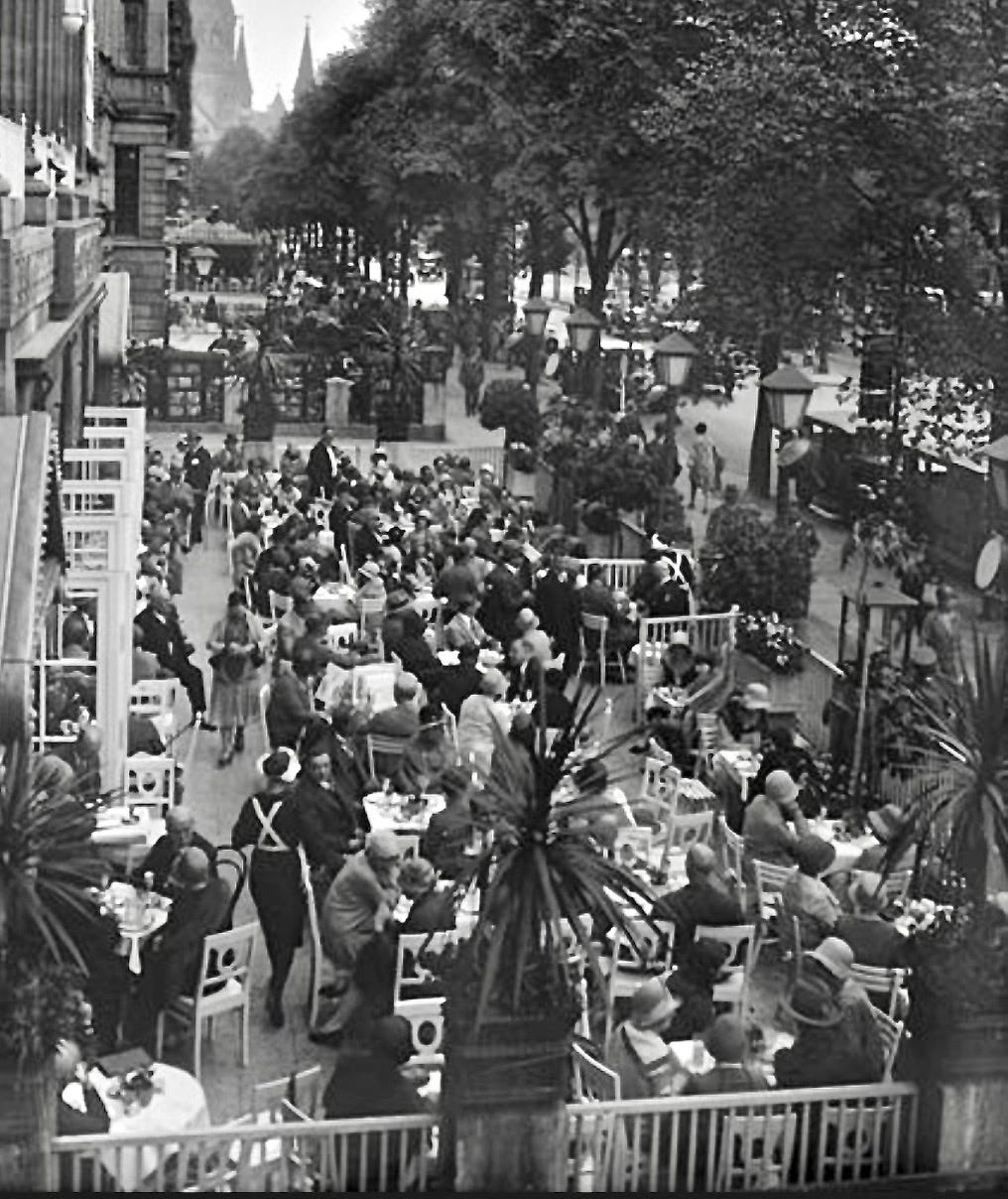
That street — the Kurfürstendamm, which Berliners had long since shortened to the Ku’damm with the easy familiarity of people who own a thing — was one of the great boulevards of Europe in the middle years of the 1920s. It was also, depending on where you stood, either proof that human beings are incurably hopeful or evidence that they are magnificently, recklessly good at forgetting. Because here is what the people on that pavement knew, and what they carried with them as lightly as they could: eight years before that Saturday night, the city had been starving. Not hungry — starving. The winter of 1916 had reduced families in working-class Wedding and Neukölln to boiling turnips for dinner, night after night, because there was nothing else. The men who had gone to war and survived came back to a city that had lost the war, lost the Kaiser, and then — in one of history’s more savage jokes — lost the value of its own money. By 1923 it cost more to paper a wall with banknotes than to buy wallpaper. A wheelbarrow of currency might purchase a loaf of bread, if you were quick about it, because prices were being chalked onto boards and changed by the hour. An entire class of people — the careful, the thrifty, the ones who had saved all their lives — watched everything they had built dissolve into worthlessness in the space of a few months. This is what Berlin had been. The dancing, the jazz, the electric signs throwing their colors onto the wet pavement — none of it makes any sense unless you hold that knowledge underneath it, the way a bruise sits beneath the skin.
I. The wreckage the decade inherited
On the ninth of November, 1918, Kaiser Wilhelm II abdicated and boarded a train to the Netherlands, and Germany became, almost overnight and without anyone having planned it that way, a republic. The war was ending — the armistice would come two days later — but in Berlin the ending felt less like relief than like the sudden removal of a wall that had been holding something back. Within hours of the Kaiser’s departure, two different men declared two different republics from two different windows in the same city. The Social Democrat Philipp Scheidemann proclaimed his from a window of the Reichstag, hoping to get ahead of the more radical voices gathering in the streets. Two hours later, from the Berlin Palace across the city, the communist Karl Liebknecht proclaimed his. The question of which Germany would emerge from the wreckage of the war had not been answered. It had simply been opened.
What followed in the next two months was not a revolution in any orderly sense. It was more like a city arguing violently with itself about what it wanted to become. Workers’ and soldiers’ councils seized control of factories and barracks across Berlin. Armed groups loyal to the old order — the Freikorps, irregular military units composed largely of demobilised veterans who had come home from the front to find a country they no longer recognised — moved through the streets with a particular kind of purposeful menace. In January 1919, the Spartacist uprising brought open fighting to the centre of the city. Rosa Luxemburg and Karl Liebknecht, the uprising’s leaders, were captured by Freikorps soldiers on the night of the fifteenth. Liebknecht was shot in the Tiergarten, the great park at the heart of Berlin, and his body dumped at a morgue as an unidentified corpse. Luxemburg was beaten, shot, and thrown into the Landwehr Canal. She was one of the most brilliant political minds in Europe. She was fifty-seven years old. Her body was not recovered from the canal for another five months.
The republic that survived all of this — the Weimar Republic, named for the city where its constitution was drafted, though it would always be governed from Berlin — was born with its wounds already showing. It had been established not by revolutionaries who wanted it but by pragmatists who feared the alternative. It was opposed from the left by communists who thought it had betrayed the revolution, and from the right by nationalists who considered it a stab in the back of a Germany that could otherwise have won the war. Neither of those beliefs was true. Both of them were loud, and persistent, and would prove, in time, to be fatal.
For ordinary Berliners, the immediate enemy was not political but physical. The blockade that the Allied powers had maintained throughout the war had hollowed the city out. The Turnip Winter of 1916 to 1917 — so named because turnips were, for months, the only food available in any quantity — had left a mark on an entire generation’s relationship with hunger that would not be easily forgotten. Children grew up stunted. The elderly died in numbers that the city had no good way of counting. And then, just as the worst of the food shortages began to ease, the economy collapsed in a different direction entirely.
The hyperinflation that consumed Germany between 1921 and 1923 is one of those historical events that sounds almost comical in description and was, in lived experience, a slow catastrophe. The German mark, already weakened by the costs of war, entered a spiral that accelerated beyond anything its citizens could track or plan around. By the autumn of 1923 it took four billion marks to buy a single American dollar. A wheelbarrow of banknotes might buy a loaf of bread — if you were quick about it, because the price would be different by afternoon. Savings accounts accumulated over decades became worthless in weeks. The class of people who had done everything right — worked steadily, saved carefully, trusted the institutions of a society that had now twice betrayed them — found themselves with nothing. It was this population, more than any other, that the coming years would find most willing to listen to anyone who offered them someone to blame.
And then, as if a switch had been thrown, it stopped. The currency was stabilised virtually overnight. American loans began to arrive. And Berlin — battered, cynical, grief-soaked, and absolutely determined — began, improbably, to party.
II. The golden years
The money arrived from America in 1924 and Berlin changed its clothes. The Dawes Plan — a package of international loans negotiated to stabilise Germany’s shattered currency and restructure its war reparations — was, on paper, a piece of financial engineering. On the ground, in the streets and shops and construction sites of a city of four million people, it felt like oxygen arriving in a room that had been slowly running out of it. Department stores opened on Potsdamer Platz. A building boom threw up apartment blocks and office towers along streets that had been crumbling quietly for half a decade. The electric trams were repaired, the street lighting extended, the cinema palaces fitted with velvet seats and orchestras. Berlin became, in the space of a few years, the third-largest city on earth, behind only London and New York — and in its own furious, provisional way, it was determined to act like it.
But Berlin was not one city. It was several, stacked against each other and overlapping at the edges, and the prosperity of the golden years fell across them very unevenly. In the west, in Charlottenburg and along the Kurfürstendamm, the bourgeoisie rebuilt their lives with American-financed confidence — the restaurants filled, the jewellers did business, the grand hotels hung their flags out again. In Mitte, the commercial and intellectual heart of the city, the Jewish community that had contributed so disproportionately to Berlin’s cultural and professional life — its publishers, its doctors, its lawyers, its department store owners — moved through the boom years with a particular kind of watchful energy, prospering in the present tense while remaining alert, as Jewish communities in Europe had long learned to be, to the sounds gathering at the edges. And to the north and east, in the working-class districts of Wedding and Neukölln, where families of five or six lived in two-room tenement apartments and the men came home from factory shifts grey with fatigue, the golden years were golden only in the sense that things were somewhat less desperate than they had recently been. The gap between the Ku’damm and Neukölln was not merely geographic. It was a different relationship to the future entirely.
It was in this city, in these years, that die neue Frau — the new woman — appeared and refused to go away. She was not a type so much as a provocation: short-haired, often employed, frequently seen in public without a male companion, in possession of the vote that the Weimar constitution had granted in 1919 and increasingly inclined to use it on her own judgment rather than her husband’s. The illustrated magazines — and Berlin in the mid-1920s had dozens of them, glossy and opinionated and selling in their hundreds of thousands — ran features on her constantly, alternating between celebration and alarm depending on the politics of the publication. She smoked, sometimes in the street. She went to the cinema alone. She worked in offices and department stores and, increasingly, in the professions. She cut her hair to the jaw and wore dresses that sat at the hip rather than the waist and showed her calves, and she danced the Charleston in clubs that her mother would not have been permitted to enter unescorted and would not have wanted to.
She was, to the conservatives who despised her, everything that had gone wrong with Germany — the abandonment of tradition, the corruption of femininity, the influence of America and jazz and modernity on a culture that ought to have known better. She was, to herself, simply a person living her life on her own terms for the first time. Both of those things were, in their way, accurate. What nobody on either side of the argument seemed to notice was how provisional it all was — how much of this freedom depended on the borrowed money flowing in from across the Atlantic, and what would happen to it the moment the loans stopped.
For now, though, the loans had not stopped. The city was loud and lit up and building itself into something new. And somewhere below the streets, in a basement club where the band had been playing for three hours without a break, a rhythm was thumping through the floor that nobody in this city had grown up hearing and that, by 1926, everybody knew by heart.
III. Sound of the city
Jazz did not arrive in Berlin gradually. It arrived the way most disruptive things arrive — suddenly, from somewhere else, and wearing clothes that the locals found either thrilling or offensive depending almost entirely on how old they were. By the early 1920s the saxophone, that most American of instruments despite its Belgian inventor, was turning up in dance halls and hotel ballrooms across the city, trailing behind it a syncopated rhythm that had no precedent in anything the German musical tradition had produced. The older critics reached immediately for the language of contamination. This was degenerate music, they wrote. Negro music. A corruption of European sensibility imported from a culture that had no business influencing one as old and accomplished as Germany’s. The younger Berliners, who had grown up on rationed food and inherited a republic nobody had asked for, mostly found that they did not care what the critics thought. The music made them want to move. That felt, after everything, like a sufficient reason.
By 1926 Berlin had more than five hundred registered dance venues. The number is worth sitting with for a moment: five hundred, in a single city, at a time when the working week ran to six days and the average factory wage left almost nothing for discretionary spending. People found the money. They found it because the alternative — staying in the two-room apartment in Wedding, listening to the walls — was not really an alternative at all. The grand dance halls accommodated thousands at a time, their floors vast and sprung, their orchestras amplified by the newest technology into something that filled the chest as much as the ears. The smaller clubs, the basement Dielen, ran hotter and darker and without much in the way of pretension. In Schöneberg, some of these clubs were gathering places for gay men and lesbians with a visibility and relative openness that existed nowhere else in Europe — a freedom fragile enough that most participants understood, without needing to be told, that it should not be examined too closely.
In the mid 1920s, Josephine Baker arrived in Berlin. She had already electrified Paris — the French had received her with the particular enthusiasm of a culture that enjoys being scandalized by talent — but Berlin was different. Berlin received her with something closer to hunger. She stood on the stage of the Theater des Westens in a costume that consisted largely of bananas and the absolute command of a performer who knew precisely what she was doing to an audience and had decided to do it anyway. The conservative press responded with the same vocabulary it deployed against jazz itself: primitive, dangerous, unsuitable. The audiences responded by returning, night after night, until every performance was sold out. Baker understood Berlin, and Berlin understood Baker, with the recognition of a city and a performer who shared a belief that the body was not something to be ashamed of and that joy, arrived at honestly, required no apology.
The cabarets were doing something different from the dance halls — less abandon, more precision. Berlin cabaret in the mid-twenties was political commentary wearing a top hat: songs that mocked the government, sketched the military as buffoons, named the profiteers and the hypocrites, and celebrated with deliberate provocativeness what polite society preferred not to acknowledge. Performers like Claire Waldoff delivered her dagger-sharp Berlin songs in an accent so thick and working-class it was itself a political statement. The young Marlene Dietrich was working the smaller stages, learning the craft of making a lyric land like a slap. And in the rooms where the composers and the lyricists gathered after the shows, a collaboration was forming between a young composer named Kurt Weill and a playwright named Bertolt Brecht that would, in August 1928, produce the Threepenny Opera — a work whose opening night audience included half of Berlin’s intellectual establishment, and whose mordant songs about money, crime, and the thin line between the two would still be playing in theatres across the world nearly a century later. It was, by almost any measure, the cultural summit of the Weimar years: the moment when everything the decade had been reaching toward — the irreverence, the political anger, the formal brilliance, the absolute refusal to be respectable — arrived in a single evening and took a bow.
Outside, through the walls of whatever theatre or club or basement Diele you happened to be in, the city continued its noise. The trams ran. The newspapers were sold. And in the kitchen of a flat in Charlottenburg, something was beginning to smell very good indeed.
IV. At the table
To understand what Berliners ate in the golden years, you first have to understand what they had eaten before them. Not in some vague historical sense, but viscerally — in the body, in the memory that bodies keep long after the mind has moved on. The Turnip Winter had ended nearly a decade ago by 1926, but the people who had boiled turnips for dinner night after night in 1916 and 1917 had not forgotten it and would not forget it. Hunger of that duration and intensity does not pass the way an ordinary bad season passes. It becomes part of how you relate to food for the rest of your life — a permanent low-frequency awareness that fullness is not guaranteed, that a plate of something hot and solid on the table is not merely fuel but a small daily argument against chaos. When the prosperity arrived and the food came back, Berliners did not eat moderately. They ate with the appetite of people who had been reminded, recently and at length, that the alternative was real.
On the street, the eating was democratic and unhurried. The Imbiss carts — the mobile food stalls that had been a feature of Berlin life for generations — were doing more business than ever, dispensing Bratwurst and Bockwurst from clouds of fragrant smoke, the sausages split and laid on grey paper with a dab of mustard, eaten standing at the cart or walking away from it with no particular ceremony. The Bouletten sellers were there too: Berlin’s beloved fried meat patties, mixed with onion and bread and seasoned with whatever was cheapest and available, served with potato salad dressed simply in vinegar and oil. These were not dishes with aspirations. They were dishes that worked — that filled a person up and cost almost nothing and tasted, particularly in the cold, of something uncomplicated and good. In the market halls, notably the great iron-roofed Markthallen whose architecture managed to make the selling of cabbages feel faintly monumental, the working-class housewives of Wedding and Neukölln did their careful arithmetic between quality and price, buying the cut of pork that would go furthest and the potatoes that would last the week.
For the city’s intellectual and artistic class, the kitchen was largely irrelevant. They ate in the cafés, and the café they ate in above all others was the Romanisches Café on the Kurfürstendamm — a large, smoky, badly lit establishment that operated as the unofficial headquarters of Weimar cultural life from roughly 1920 until the decade’s end. Einstein had been known to sit there. Brecht came regularly, occupying a corner table with the deliberate self-consciousness of a man who knew he was being watched. The journalist and satirist Kurt Tucholsky filed his columns from its tables. The painters George Grosz and Otto Dix argued about art in it. The chess players occupied one section, the journalists another, the painters a third, and the writers a fourth — distinctions understood by all regulars and largely ignored when the arguments became interesting enough. The food was not the point. The food was Kaffee und Kuchen — coffee and cake, the great German social sacrament — and perhaps a plate of Schnitzel if the afternoon had run long into the evening. The Romanisches ran on coffee and argument. It was where Berlin thought out loud, and the thinking rarely stopped before midnight.
And then there was America. American influence arrived in Berlin’s food culture alongside the loans and the jazz and the cinema, and it provoked, in miniature, exactly the same argument. The first cocktail bars appeared in the mid-twenties, serving drinks mixed according to recipes that had never been seen east of Paris. Canned goods began appearing in the smarter grocery stores — pineapple, condensed milk, processed meats in tins — novelties of an industrial modernity that some Berliners embraced as evidence of progress and others regarded with the suspicion usually reserved for things that have no smell. The department store restaurants served American-style quick lunches to office workers who had neither the time nor the inclination for a full midday meal. Whether this was civilisation advancing or something being lost in the translation was, like most questions in Weimar Berlin, a matter of which newspaper you read in the morning.
Outside, on the pavement in front of the Romanisches, a painter was walking past with a portfolio under his arm and paint on his hands and an expression that suggested he had recently seen something that disturbed him profoundly and intended to make everyone else see it too.
V. What the painters saw
The painter walking past the Romanisches Café with paint on his hands was quite possibly George Grosz, who lived nearby and who had, by the mid-twenties, developed a visual vocabulary for Weimar Berlin so precise and so damning that it remains the decade’s most honest self-portrait. Grosz drew and painted the city as a pathologist examines a body — not with hostility exactly, but with the cold, systematic attention of someone for whom a clear diagnosis matters more than a flattering one. His Berlin was populated by profiteers with porcine faces and cigars, by maimed veterans begging on streets walked by men who had sent them to war, by judges and generals and priests arranged in compositions that left no doubt about what Grosz thought of the compact between power and respectability in Weimar Germany. He was sued for obscenity and blasphemy on multiple occasions. He considered this evidence that his work was accurate.
Otto Dix, who had fought in the trenches and come back to painting with something broken and clarified behind his eyes simultaneously, worked in a register that made even Grosz look forgiving. His triptych Metropolis — painted in 1928, the year of the Threepenny Opera’s premiere, the year when everything the golden years had promised seemed most real — showed the Berlin nightlife from a perspective nobody at the Romanisches Café’s better tables would have recognised: jazz musicians playing for dancers while crippled war veterans crawled through the street outside, invisible to the party above them. Dix was not making an argument. He was making a record. The genius of the New Objectivity — the Neue Sachlichkeit, the movement to which both men loosely belonged — was precisely this refusal to argue. It simply showed, with a draughtsman’s precision and a surgeon’s lack of sentiment, what was there to be seen by anyone who wished to look.
While the painters were diagnosing the city, the Bauhaus was quietly redesigning it. The school itself was based first in Weimar and then in Dessau — never in Berlin — but its influence on the capital’s visual life in the twenties was pervasive in the way that a new grammar is pervasive: not always visible as a distinct thing, but present in the structure of almost everything. Bauhaus typography appeared in Berlin’s advertising posters, in its magazine layouts, in the lettering above its shop fronts. Bauhaus furniture — tubular steel chairs, functional lamps, objects that declared their purpose without ornament — began appearing in the apartments and offices of the design-conscious. The movement’s central proposition, that beauty and function were not opposites but had always been the same thing wrongly separated, was radical enough in 1919 to get the school evicted from Weimar by a conservative government that associated clean lines with dangerous ideas. By the mid-twenties in Berlin, those clean lines were in the windows of the better department stores. The Bauhaus did not produce a style so much as a permission — the permission to ask, about any object in the world, whether it could be made more honest.
At Babelsberg, in the studios of the UFA film company on the southern edge of Berlin, a different kind of making was happening on a different kind of scale. The UFA was producing films in the twenties that were doing something no other national cinema was attempting: constructing, out of light and shadow and the architecture of the human face, a visual language of dread. F.W. Murnau had made Nosferatu in 1922, a film whose shadows leaned at angles that shadows in the physical world do not lean, whose monster arrived not as a figure of Gothic fantasy but as something disturbingly plausible — bureaucratic, patient, feeding on a city that had not noticed him yet. Fritz Lang’s Metropolis arrived in 1927, a film of extraordinary scale and stranger beauty, in which a future city built on human labour was imagined with the detail of an architect and the nightmares of a man who had spent years watching what industrialisation actually did to the people at the bottom of it. When the Nazis drove the German filmmakers into exile in 1933, Hollywood received them with gratitude and put their visual grammar immediately to work. The shadows of Weimar cinema fell, quite literally, across the entire subsequent history of American film.
All of this — the paintings, the furniture, the films, the songs — was being made in a city where, on certain streets and on certain nights, men were already fighting over what kind of future Germany was going to have. Not metaphorically. With fists, and worse.
VI. The floor gives way
The violence had always been there. This is the thing that the golden years, in their noise and light and borrowed confidence, made it easy to forget — or perhaps not forget exactly, but file away, the way you file a sound you have decided not to investigate. Throughout the mid-twenties, while the Romanisches Café argued about art and the dance halls counted their five hundred crowds and die neue Frau walked the Ku’damm on her own terms, the streets of the working-class districts were hosting a different and uglier argument. Communist Red Front fighters and Nazi Sturmabteilung — the SA, the brownshirts — moved through the same neighbourhoods with the mutual awareness of men who have decided that the question between them will eventually be settled by force and are simply waiting for the right occasion. The occasions, as the decade progressed, became more frequent and less occasional. Meetings ended in brawls. Brawls escalated into running fights through tenement streets. The dead were counted, named in the newspapers of their respective movements, and turned into martyrs whose deaths required answering.
The Nazi Party in Berlin was, through most of the golden years, a fringe operation — noisy, violent, and largely dismissed by the city’s liberal and intellectual establishment as the kind of phenomenon that prosperity would eventually dissolve. Joseph Goebbels arrived as the party’s Berlin Gauleiter in 1926 and understood immediately that the city’s cosmopolitan, left-leaning character was not an obstacle to be overcome but a provocation to be exploited. He staged rallies in Communist strongholds specifically to invite attack, then used the resulting violence as evidence of the republic’s failure to maintain order. He published a newspaper, Der Angriff — The Attack — whose targets were the republic, the Jews, and the comfortable classes who had decided that what was happening in Wedding and Neukölln did not concern them. The comfortable classes continued, for the most part, to make that decision. It was, in retrospect, the most expensive miscalculation of the century.
On the twenty-fourth of October, 1929, the New York stock market collapsed. The news reached Berlin within hours and was received, at first, with the detachment that distant catastrophes tend to inspire — unfortunate, certainly, but American, and therefore perhaps not entirely relevant. Within weeks it was entirely relevant. The American loans that had been flowing into Germany since 1924 — the loans that had stabilised the currency, funded the building boom, put the velvet seats in the cinema palaces and the orchestras in the dance halls — were called in. The mechanism that had built the golden years ran in reverse with the same speed and thoroughness with which it had run forward. Businesses that had expanded on credit contracted or failed. The unemployment figures, which had been falling throughout the boom years, reversed direction with a momentum that the government had no tools to slow. Within two years, unemployment in Berlin would pass six hundred thousand. The Romanisches Café began to empty. The cabarets began to struggle. And on certain streets, the brownshirts were no longer a fringe.
What happened next belongs to a different story — or rather, to the same story told in a different decade, a different register, at a volume that would make the noise of the golden years sound, in memory, like quiet. What matters here, at the end of this particular decade, is not the catastrophe that followed but what the catastrophe consumed. It consumed the paintings and burned the books and drove Grosz and Dix and Lang and Weill and Tucholsky and hundreds of others into exile, scattering them across a continent and then across the world, where they carried what Berlin had made in their hands like something saved from a fire. It shuttered the cabarets and closed the clubs in Schöneberg and removed from public life, with a systematic thoroughness that must be called by its right name, the Jewish community that had contributed so immeasurably to everything this decade had been. It cancelled die neue Frau and told women to go back to the kitchen and the church and the nursery, and many did, because the alternative had been made plain.
The bruise had always been there. It had simply, in the end, been pressed hard enough to show.
Go back to that Saturday night. Go back to the Ku’damm and the electric signs and the tram throwing sparks and the bass notes thumping up through the wet pavement from somewhere below. It is still 1926. The man in the top hat is still arguing with nobody in particular. The boy is still selling newspapers and the people are still not stopping to read them. The woman in the low-waisted dress is still walking, unhurried and unaccompanied, in the cold light of the jeweler’s window, and she looks like someone who has recently discovered that the future belongs to her. In a sense, it does. In a sense that would take less than a decade to reveal itself, it does not.
What Berlin made in the 1920s — the art, the music, the architecture, the hard-won social freedoms, the very idea that a city could be a place where almost anything was permitted and almost anyone could belong — was real. It happened. The Nazis burned the books and shuttered the cabarets and drove the artists and the writers and the filmmakers into exile, scattered them across Paris and London and New York and Hollywood, where they went on making things that still shape what we see and hear and read today. But they could not un-happen the decade. They could not reach back to that Saturday night and take it from the people who were living it. The bruise was always there, yes — underneath the dancing, underneath the jazz, underneath the amber and white and cold blue-green of the signs. But the dancing was also always there. That is what you have to hold onto. Both things, at the same time, with equal seriousness. A city that knew what devastation felt like, and chose, for one extraordinary decade, to answer it with everything it had.
The floor gave way in the end. It always does. But for a while — for one wet, loud, improbable Saturday night that lasted the better part of ten years — Berlin was the most alive city on earth. And the people walking its streets had no way of knowing, and every reason not to ask, and so they walked on.
© The European Century · europeancentury.substack.com
Sources
Books: Richard Evans, The Coming of the Third Reich (2003). Eric Weitz, Weimar Germany: Promise and Tragedy (2007). Alexandra Richie, Faust’s Metropolis: A History of Berlin (1998). Peter Gay, Weimar Culture: The Outsider as Insider (1968).
Primary sources: Harry Kessler, Berlin in Lights: The Diaries of Count Harry Kessler, 1918–1937 (trans. Charles Kessler, 1999). Christopher Isherwood, The Berlin Stories (1945).
Image sources: Bundesarchiv (bild.bundesarchiv.de) · Wikimedia Commons
Further reading: Volker Ullrich, Hitler: Ascent 1889–1939 (2016) · Mel Gordon, Voluptuous Panic (2006).