


When the Germans arrived, they brought lists of what music was forbidden. Paris played it anyway — and in doing so, turned a saxophone into an act of resistance.
Sound of the Streets · Paris · 1940–1944 · 2,800 words
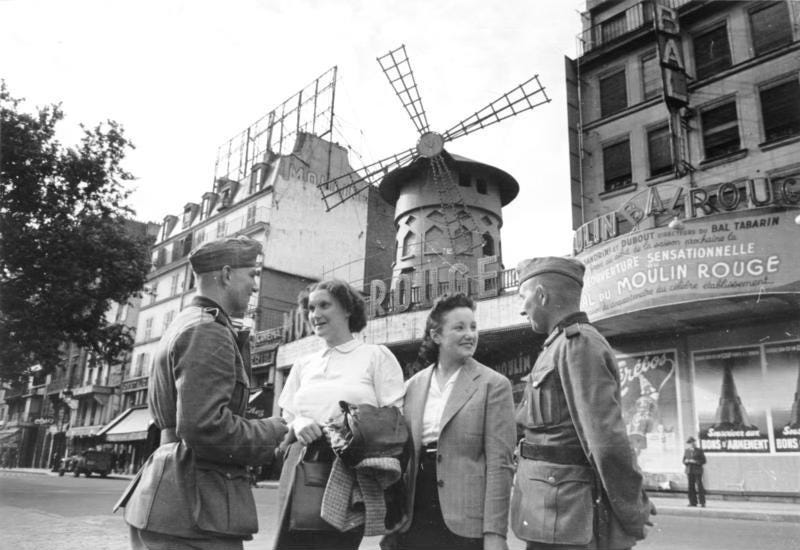
On the fourteenth of June, 1940, German soldiers marched down the Champs-Élysées. The city was quiet in a way Paris had never been quiet before — not the comfortable quiet of a Sunday morning or the particular hush that falls before a summer storm, but the quiet of a place that has stopped breathing. Shops were closed. Cafés sat empty. Somewhere in the distance, a dog barked once and fell silent. The soldiers marched in columns, their boots on the cobblestones making the only sound in the most musical city in Europe.
Within days, the orders arrived. Jazz was degenerate music — *Negermusik*, the Nazis called it, the same word they had used in Berlin in the twenties before driving its practitioners into exile. Swing was banned. American song titles had to be translated into French or German before they could be performed. Jewish musicians were prohibited from performing at all. The Propaganda-Staffel, the German military cultural authority that now controlled what Paris could and could not hear, issued a list of proscribed composers and performers. It was a long list. Paris looked at it, put it in a drawer, and went to the jazz club.
What happened to music in Paris between June 1940 and August 1944 — through four years of occupation, rationing, curfew, and fear — is one of the strangest and most revealing stories in the history of the twentieth century. It is a story about what music means when the stakes are no longer merely cultural. It is a story about compromise, collaboration, courage, and the particular human stubbornness that insists on dancing even when dancing has been made dangerous. And at its centre stands a single instrument — the guitar, in the hands of a half-Belgian Romani musician named Django Reinhardt — that became, without anyone quite planning it that way, the sound of a city refusing to be silenced.
---
## I. What the Germans wanted to hear
The German occupiers were not, as a rule, indifferent to culture. Many of them were educated men who had grown up with Wagner and Brahms and considered themselves the inheritors of a serious musical tradition. What they objected to was not music in general but a specific kind of music — the syncopated, improvised, African-American-derived music that had taken Europe by storm in the 1920s and that the Nazi cultural apparatus had identified as a particular threat to German racial purity. The contradiction that immediately presented itself — that many of the soldiers stationed in Paris privately loved jazz and frequented the very clubs their orders told them to close — was one that the occupation authorities resolved with the particular German bureaucratic talent for ignoring what is inconvenient.
The official position was clear: jazz was forbidden, swing was dangerous, and the music of Jewish or Black composers was not to be performed in public. The practical position was rather different. The Propaganda-Staffel issued its prohibitions and then spent the next four years failing to enforce them, partly because enforcement would have required closing every nightclub and music hall in Paris, and partly because the soldiers who were supposed to be doing the enforcing kept turning up at those same nightclubs to listen. A Wehrmacht officer photographed at a Paris jazz club in 1942 — and there are several such photographs in the archives — presents a particular challenge to the clean narrative of cultural resistance that postwar France preferred to construct.
What actually happened was more complicated and more human than either the official Nazi position or the postwar French mythology suggest. Paris under occupation was a city of negotiation — constant, exhausting, morally compromising negotiation between what was forbidden and what was necessary, between survival and dignity, between the pragmatic accommodation that kept you alive and the small acts of defiance that kept you human. Music sat at the center of that negotiation, as it always does in cities under pressure, because music is the one cultural form that can mean different things to the person performing it and the person listening simultaneously.
---
## II. Django and the sound of elsewhere
Jean Reinhardt — Django to everyone who had ever heard him play — was born in a Romani caravan in Belgium in 1910 and had taught himself to play guitar with a technique that should not have worked and demonstrably did. A fire in 1928 had left two fingers of his left hand permanently fused and partially paralyzed. He had spent two years learning to play with what remained — two functional fingers on his fretting hand — and had emerged from that process with a technique so idiosyncratic and so fluent that other guitarists could not decide whether to pity or envy him. By 1940 he was the most celebrated jazz musician in Europe, the co-founder with violinist Stéphane Grappelli of the Quintette du Hot Club de France, and the creator of a music so distinctly his own that it defied easy categorization: jazz, yes, but also Romani, also French, and also something that belonged to no tradition except the one he was inventing in real time.
When the Germans arrived, Grappelli was in London and stayed there. Django was in Paris and, for reasons that remain debated by biographers, stayed too. As a Romani man he was in acute danger — the Nazis were simultaneously persecuting the Romani people with the same systematic thoroughness they were applying to the Jews of Europe — and yet Django continued to perform, to record, to appear at the clubs of Montmartre and Saint-Germain-des-Prés, negotiating the occupation with the pragmatic instinct of a man who had spent his entire life operating outside whatever system the authorities happened to be running. He attempted to flee to Switzerland at least once and was turned back. He came under scrutiny from the Gestapo at various points. He kept playing.
What he played, and how he played it, is the key to understanding music in occupied Paris. Django’s guitar was French swing rather than American jazz — it used acoustic instruments rather than the electric guitar and horn sections of American big band, and this gave it a plausible deniability the German authorities were perhaps too relieved to exploit. Here was a music that could be presented, with a straight face, as a European form rather than an American one — the jazz had been absorbed and transformed into something that belonged to the cafés of Paris rather than the ballrooms of Harlem. The Germans were not entirely fooled, but they were sufficiently convinced to allow the music to continue, which was, for a city under occupation, as much of a victory as victory was going to look like.
> **Historical Fun Fact — Django’s shadow reaches Georgia**
> Django Reinhardt’s two-fingered guitar technique — the product of the 1928 caravan fire that fused the ring and little fingers of his left hand — cast a longer shadow than even his most devoted listeners knew. In 1973, Dickey Betts of the Allman Brothers Band wrote *Jessica*, the instrumental that opens side two of *Brothers and Sisters*, as a deliberate tribute to Reinhardt: a melody specifically composed to be playable with only two fingers, in honour of what the Romani guitarist had achieved under the same constraint. Betts was watching his infant daughter Jessica crawl across the floor of his writing room when the melody came to him — but the technical inspiration behind it ran directly from a burning caravan outside Paris in 1928 to a recording studio in Georgia forty-five years later. *Jessica* became one of the most beloved instrumentals in American rock history, later recognized as the theme music for the UK television show *Top Gear*. Django, one suspects, would have approved.
---
## III. The cellars of Saint-Germain
While Django negotiated the surface of the occupation with his guitar, another music was developing in the cellars beneath it. The cave bars and basement clubs of Saint-Germain-des-Prés — those damp, low-ceilinged rooms that smelled of cheap wine and cigarette smoke and would later become synonymous with existentialism and the postwar Left Bank — were during the occupation something slightly different: they were spaces outside the German gaze, rooms where the curfew-defying young of Paris gathered to dance and drink and listen to music that was, by any reasonable interpretation of the Propaganda-Staffel’s guidelines, completely illegal.
The zazous were the defining social tribe of occupied Paris — young people, mostly middle-class, who expressed their refusal of the occupation through a deliberately excessive style: the boys in long jackets with padded shoulders, narrow trousers, and thick-soled shoes, their hair brilliantined into elaborate quiffs; the girls in short skirts and platform heels, carrying umbrellas regardless of the weather. They were devotees of swing and jazz, and they gathered in the basement clubs to dance the jitterbug — an American dance that was, under the letter of the German cultural law, as forbidden as anything could be. Their weapon was style. Their statement was the refusal of austerity in a city where austerity had been imposed not merely as an economic necessity but as a cultural program.
The Nazis found the zazous infuriating and periodically rounded them up for haircuts — a punishment both humiliating and revealing, since a regime that is reduced to cutting people’s hair has already conceded that it cannot control their minds. The Vichy government, embarrassed by the zazous’ implicit mockery of its collaboration, occasionally prosecuted them for black market offences. None of it stopped the dancing. The basement clubs stayed open, the jazz played on, and on certain nights in certain cellars in Saint-Germain, if you knew which door to knock on and what to say when it opened, you could hear music that sounded, for a few hours, like freedom.
---
## IV. Édith Piaf and the complicated question of collaboration
The story of music under the occupation is not only a story of resistance. It is also, uncomfortably, a story of performance for the enemy — of French musicians who played to German audiences, who accepted German patronage, who continued their careers under the occupation in ways that required a degree of accommodation with the occupying power that would later prove difficult to explain. Édith Piaf performed throughout the occupation, including for French prisoners of war in Germany — a fact that was later used both to condemn and to defend her, since the same concerts that gave comfort to the prisoners also demonstrated a willingness to operate within the German cultural system that her postwar admirers preferred not to examine too closely.
The music hall tradition — the *chanson française*, the great French tradition of the singer-songwriter performing intimate songs of love and loss and the particularities of Parisian life — occupied a peculiar position under the German occupation. It was French enough to be tolerated, popular enough to be genuinely enjoyed by the German soldiers who packed the music halls alongside their French audiences, and sufficiently non-political in its surface content to avoid the most serious attention of the censors. Piaf’s songs did not speak of resistance or collaboration, occupation or liberation. They spoke of love, of loss, of the specific gravity of the human heart. This was, depending on how you looked at it, either an evasion of political responsibility or a form of cultural preservation — or, most accurately, both at once, held in the uncomfortable tension that was the defining condition of life in occupied Paris.
---
## V. Liberation and the sound of August 1944
On the twenty-fifth of August 1944, General de Gaulle walked down the Champs-Élysées. The route was the same one the German soldiers had marched four years and two months earlier, in the opposite direction, and the contrast was not lost on the crowd that lined the boulevard ten deep. The city had been under curfew for so long that the instinct to be indoors at nightfall had become physiological rather than merely legal, and it took several days before the people of Paris fully believed that the curfew was gone — that they could walk the streets at night again, that the lights could stay on, that the music could play until morning.
The jazz that erupted in Paris in the weeks following liberation was not simply a return to what had existed before the occupation. It was something new — charged with four years of suppressed energy, transformed by the American jazz musicians who arrived with the liberating forces and who brought with them the beginnings of bebop, a music that made swing sound as quaint and comfortable as a parlour song. The encounter between the sophisticated European jazz tradition that Django represented and the new American music arriving with the liberators was one of the most fertile collisions in the history of the form, and it happened in the bars and clubs of Paris in the autumn and winter of 1944 with the particular intensity of people who had been waiting a very long time.
Django himself, who had survived the occupation by a combination of talent, nerve, and the particular genius of his instrument for being hard to categorise, embraced the new music with the same hungry curiosity that had made him Django in the first place. He picked up the electric guitar — which he had previously resisted — and began to listen seriously to Charlie Parker and Dizzy Gillespie. He died in 1953, young enough that we can only guess how far he would have travelled with the new music. But on those first nights of liberation, playing in the clubs of a city that had just remembered how to breathe, he was already somewhere new — somewhere that could not have existed without the four years of silence that had preceded it.
---
There is a question that hovers over the whole story of music in occupied Paris and that does not resolve itself cleanly into either heroism or shame. It is the question of what music is for when the normal conditions of cultural life have been suspended — when the concert hall is controlled by the enemy, when the record label is answerable to the censor, when the audience includes both the people who want you dead and the people who need you to play.
The answer that Paris gave across four years was not a single answer. It was Django playing to the Germans and the resistance simultaneously. It was Piaf singing of love while the Gestapo occupied the next table. It was the zazous dancing the jitterbug in a basement while the occupation authorities tried to figure out whether jitterbugging counted as a crime. It was the musicians who collaborated and the musicians who refused and the large majority who did something in between and have never fully explained themselves, partly because the explanation resists the clean moral categories that postwar France preferred to apply to the occupation and partly because they were not sure, even at the time, exactly which category they fell into.
What is certain is that Paris in the 1940s produced, under the most adverse circumstances imaginable, some of the most vital music of the twentieth century. That is not a comfortable fact. It is not supposed to be. History rarely is.
---
## Sources & further reading
- *Django: The Life and Music of a Gypsy Legend* — Michael Dregni (2004). The definitive English-language biography.
- *Paris After the Liberation 1944–1949* — Antony Beevor & Artemis Cooper (1994). Essential wider context for the liberation period.
- *Suite Française* — Irène Némirovsky (written 1941–42, published posthumously 2004). Fiction, but the most vivid primary account of the occupation’s texture.
- *The Shameful Peace: How French Artists and Intellectuals Survived the Nazi Occupation* — Frederic Spotts (2008). The best account of the collaboration question in cultural life.
- Primary sources: INA (Institut National de l’Audiovisuel) archive recordings · Bibliothèque nationale de France occupation-era press archive.
---
*© The European Century · europeancentury.substack.com*
---
**Tags:** sound-of-the-streets · paris · jazz · world-war-two · french-history · django-reinhardt · occupied-france · european-music · 1940s