


Decade Portraits · The European Century
Occupation, liberation, starvation, euphoria, existentialism, and the slow, complicated business of deciding what kind of city — and what kind of country — France intended to become.
Decade Portrait No. 2 · Paris · 1940–1949 · approximately 5,200 words
The city is not quiet. That is the first thing you notice — not the silence you expected but something stranger, a sound that is the shape of silence without being silence itself. The birds are singing. A cat crosses the rue de Rivoli without looking either way. Somewhere behind you, in an apartment above a shuttered bakery, someone is playing a radio at low volume — something light, something from before the war — and the music drifts down to the empty street and dissolves into the morning air without anyone to hear it. The chairs are still stacked outside the café on the corner. A newspaper blows against a doorstep and stays there, unopened. Paris in the morning has always had a particular quality of suspended time, that interval between the night people going home and the day people coming out, but this morning the suspension has a different character — it is not the pause of a city gathering itself to begin. It is the pause of a city that does not know what it is about to become.
You walk and your footsteps are the loudest thing on the boulevard. The windows above you are shuttered, the curtains drawn, though it is past nine o’clock. Two weeks ago these streets would have been full by now — the market carts on their way to Les Halles, the office workers crossing the bridges, the schoolchildren in their uniforms with their satchels banging against their hips. Some of them are gone — the roads south have been full for days, two million people moving through the city toward anywhere that is not here, their furniture strapped to the roofs of cars, their best possessions in whatever bags and cases they could carry. You stayed. You are not sure, standing now on the empty boulevard with the birds singing overhead and the cat watching you from a doorway, whether staying was an act of courage or of stubbornness or simply of an inability to believe that what everyone said was coming could actually be coming here, to this city, to these streets that have always been what Paris means when it says it is Paris.
The morning smells of stone and of the Seine a few streets away and of something faintly charred — smoke from the north, from the refineries at Rouen that someone burned before retreating, a smear of black against the pale June sky that has been visible for two days and that everyone is pretending not to look at. You look at it now. Then you look back at the empty street, at the unopened newspaper on the doorstep, at the curtained windows, at the stacked chairs. You think: there is still time. You think: perhaps. You think nothing more than that, because beyond that thought there is something you are not yet prepared to think.
The 1940s in Paris is not one story. It is four — occupation, liberation, reckoning, and reconstruction — and understanding the decade requires holding all four simultaneously, resisting the temptation to let any one of them absorb the others. The liberation was real, and the joy of August 1944 was real, and neither of those facts makes the four years of occupation that preceded it any less real, nor the difficult, morally complicated years that followed any less difficult. This is a decade that does not resolve cleanly into either heroism or shame, and any account that tries to make it do so has not looked closely enough.
I. The city that stayed
On June 14, 1940, the German soldiers arrived. Paris had been declared an open city — a designation that preserved its architecture at the cost of its dignity — and the Wehrmacht entered without resistance. The swastika was raised on the Eiffel Tower. The clocks were moved to Berlin time. The Hôtel Majestic on the avenue Kléber became the headquarters of the German military administration in France, and the apparatus of occupation — its offices, its censors, its lists and its prohibitions — settled over the city with the systematic thoroughness of a bureaucracy that had been preparing for exactly this.
Of Paris’s three million inhabitants before the war, roughly two million had fled during the exodus of May and June 1940 — one of the largest population movements in European history, eight million people on the roads south, carrying what they could, heading toward anything that was not here. They travelled in cars piled with furniture, on bicycles with suitcases strapped to the handlebars, on foot with children on their shoulders. The German air force strafed some of the columns. The roads were chaos and the chaos was deliberate.
Those who remained in Paris — by choice, by poverty, by age, by the particular human difficulty of leaving the place that contains your entire life — faced a set of conditions that would define the next four years. The curfew ran from eleven at night to five in the morning, enforced strictly, and its effect on the rhythms of Parisian social life was profound: a city whose identity was inseparable from its nocturnal culture found itself compulsorily domestic after dark. The German administration requisitioned hotels, office buildings, and private apartments. German soldiers — polite, in the early months, conspicuously on their best behavior — were visible everywhere, in the cafés and the museums and the bookshops, tourists in uniform in a city they had been taught to regard as the cultural capital of the world.
The Demarcation Line dividing France between the Occupied Zone in the north and the Vichy government’s zone in the south was not merely a geographic boundary. It was a division of possibility — of what you could do, where you could go, who you could contact. Letters crossing the line were opened and read. Travel required papers that were difficult to obtain and easily revoked. The line turned France into two countries that were required to cooperate with each other and forbidden to trust each other, and the resulting moral complexity was not confined to the politicians. It descended into the smallest details of ordinary life.
The Vichy regime — established in July 1940 under Marshal Philippe Pétain, the hero of Verdun turned collaborationist head of state — is important to understand not as something imposed on France by the Germans but as something offered by the French themselves. The armistice that created Vichy was not the result of German demand; it was the result of a vote in the French National Assembly, 569 votes to 80, to grant Pétain full powers and to end the republic. The men who voted for it were not all cowards or fascists. Some of them were exhausted, traumatized by the speed of the military collapse, genuinely persuaded that accommodation was the only realistic path. They were wrong, and the wrongness of their decision would take decades to fully acknowledge. But it was a French decision, made by French men, in a French assembly. That fact is essential to any honest account of what followed.
II. Hunger and the black market
To understand what the occupation felt like from the inside, begin with food. Not with politics or resistance or the German administration’s cultural prohibitions — with the ration card, the queue, and the slow arithmetic of how to feed a family on what was permitted.
The German requisitioning of French agricultural production reduced Paris to near-starvation conditions within two years of the occupation’s beginning. By 1941, Germany was extracting roughly a fifth of France’s total food production — meat, dairy, grain, vegetables — for the Reich’s own consumption, leaving French civilians to subsist on what remained after the extraction. The ration card divided the population into categories: J1 for children, J2 for adolescents, A for adults, V for the elderly, T for manual workers. Each category received different entitlements, all of them inadequate, none of them reliable, since the goods nominally available on the ration were frequently absent from the shelves when you arrived to collect them.
The queue became one of the defining social experiences of occupied Paris. Women — it was almost always women — spent hours outside bakeries and butchers’ shops for food that had often run out before they reached the counter. The waiting was not merely inconvenient; it was exhausting in a cumulative, grinding way that wore at the spirit as much as the body. It also created, paradoxically, a new kind of social space — the queue as information exchange, rumor mill, and site of the particular solidarity that comes from shared deprivation. Women who had never spoken to each other before the war stood in line together for months and became, in a muted and practical way, neighbors.
What people actually cooked was constrained to a degree that required genuine ingenuity to work around. Rutabaga appeared again on Parisian tables — the same unloved turnip that had sustained Berlin through its own worst winters in 1916 and 1917 — along with Jerusalem artichokes, chicory, and ersatz coffee made from ground acorns or roasted barley. Bread was available but adulterated, often containing bran, sawdust, or other fillers that reduced its caloric value and made it dense and grey. Meat was scarce enough that a piece of genuine beef became an occasion.
The black market — the marché noir — was the occupation’s great social equalizer and its great moral ambiguity simultaneously. Everyone used it. Everyone knew that everyone used it. The German authorities tolerated it to a degree, recognizing that cracking down completely would produce starvation and unrest rather than compliance. Farmers sold produce directly to buyers who arrived at their farms in the early morning. City dwellers with country connections arranged for packages to be brought in on trains. Those with money bought what others could not afford, and the gap between the food available to the wealthy and the food available to the poor grew in ways that produced a particular kind of resentment — the same anger, at different intensities, that the occupation generated in almost every aspect of daily life.
Against this background, the grand restaurants that remained open and continued to serve — Maxim’s on the rue Royale, La Tour d’Argent overlooking Notre-Dame — served as a kind of visual affront to the rest of the city. Their dining rooms were full of German officers and French collaborators eating food that the people outside on the pavement could not access. To walk past Maxim’s in 1942, when your ration card entitled you to a few hundred grams of bread per day, required a particular kind of studied indifference that not everyone was able to maintain.
III. The Vel d’Hiv
During the two days of July 16 and 17 in 1942, French police officers — not German soldiers, but French gendarmes carrying out orders that had come, ultimately, from the Vichy government — arrested 13,152 Jewish men, women, and children in Paris and its suburbs. The operation was called the Rafle du Vélodrome d’Hiver. It took two days to complete. The people arrested were taken to the Vélodrome d’Hiver, a covered sports stadium in the fifteenth arrondissement, and held there for five days in conditions of deliberate cruelty: no food, almost no water, no sanitation, no medical care, the summer heat building inside the glass-roofed building until it became unbearable. 4,115 of those arrested were children.
From the Vel d’Hiv they were taken to the internment camp at Drancy on the northeastern outskirts of Paris. From Drancy they were deported east, to Auschwitz. None of the children survived.
The French government did not acknowledge state responsibility for the Vel d’Hiv roundup until 1995, when President Jacques Chirac became the first French head of state to formally recognize that the French Republic bore responsibility for what its police had done. That gap — fifty-three years between the crime and the acknowledgement — is not an accident or an oversight. It is a measure of how thoroughly the postwar French mythology of universal resistance required the Vel d’Hiv to be treated as something done to France by an outside force, rather than something done by France to its own citizens.
The names of the arresting officers are in the archives. The names of those arrested are in the archives. The orders came from Paris, not from Berlin.
IV. Culture under the occupation
The cultural life of occupied Paris was, by almost any measure, surprisingly active. Theaters stayed open. Films were made. Galleries showed work. Books were published. The question of what that activity meant — who it served, what it cost, and what moral position it occupied — is one that Paris spent the better part of the subsequent century refusing to answer directly.
Pablo Picasso remained in his studio on the rue des Grands-Augustins throughout the occupation. He did not flee, and he was not required to flee — the Nazis considered his work degenerate, but he was internationally famous enough that arresting him would have been a propaganda disaster. German officers came to his studio in a spirit that combined genuine admiration with the particular need that powerful men have to be acknowledged by those they have chosen to persecute. He received them without warmth. When one officer, looking at a reproduction of Guernica, asked whether Picasso had done that, he replied: “No — you did.” He kept working. Whether continuing to work under occupation constituted a form of resistance, a form of accommodation, or simply the activity of a man who could not not make things is a question that admits no clean answer.
The Continental Films studio, owned by the German occupiers, employed French directors, actors, and crews throughout the occupation. The people who worked there needed the income, and the films they made were not, for the most part, propaganda — they were entertainments, comedies, thrillers, the ordinary product of a film industry doing its work in the only conditions available. This is, depending on your position, either a practical response to impossible circumstances or a form of collaboration. It is almost certainly both.
Jean-Paul Sartre staged his play The Flies at the Théâtre de la Cité in 1943. It is an adaptation of the Orestes myth, and on its surface it is simply that: a Greek tragedy in modern dress. Beneath the surface it is a meditation on freedom and responsibility, on the individual’s capacity to act in defiance of authority, on the possibility of refusing the guilt that power imposes on the powerless. The German censors either failed to grasp its argument or calculated that banning it would create more attention than allowing it. It played to full houses. Whether its audiences understood it as an allegory of occupation, whether Sartre intended it to be understood that way, and whether the performance itself constituted an act of resistance or merely an evening’s entertainment are questions that The Flies has been provoking ever since.
The Paris couture houses — Chanel, Balenciaga, Rochas — remained open throughout the occupation, creating elaborate and extravagant designs that bore no relationship to the material conditions of the city outside their doors. This was interpreted by some as an assertion of French cultural identity — an insistence that Paris was still Paris, whatever flags flew from its monuments — and by others as a form of collaboration so comfortable that it barely noticed itself. Both interpretations contain truth. The fashion industry’s most prominent figures made different choices, and those choices existed on a spectrum from genuine complicity to genuine courage, with most of the industry clustered in the ambiguous middle.
V. Liberation and the complicated joy of August 1944
On August 19, 1944, the French resistance rose in Paris. The city’s police had gone on strike four days earlier, and in the absence of German enforcement, the resistance began seizing public buildings, erecting barricades, and fighting in the streets. It was a deliberate political act as much as a military one: Charles de Gaulle needed Paris to liberate itself, or at least to appear to do so, before the Allied armies arrived. A liberation achieved entirely by American and British forces would have produced a France that owed its freedom to others. A liberation achieved by Frenchmen — even with substantial Allied support — could be narrated, and de Gaulle was above all a narrator, as a French act.
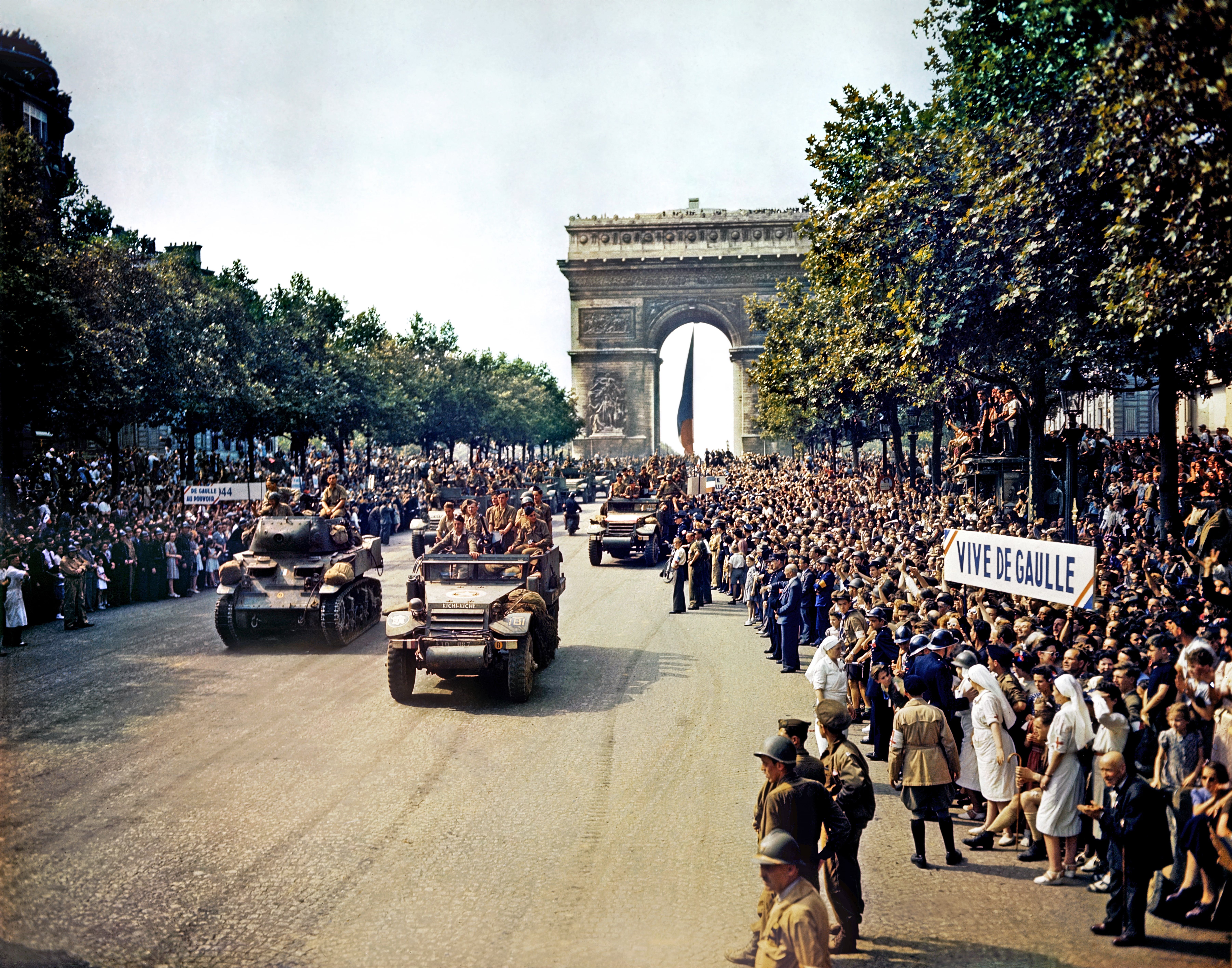
On August 25, General de Gaulle walked down the Champs-Élysées. The crowd that lined the boulevard was ten deep in places, and the sounds they made — cheering, crying, singing — were audible from a considerable distance. Snipers fired from rooftops during the march, and de Gaulle did not flinch or take cover. He had understood before the march began that if he flinched, the image of a French leader flinching in the moment of liberation would be the image that survived. He walked at a steady pace from the Arc de Triomphe to Notre-Dame, and the image that survived was of a very tall man walking through an adoring crowd with the unhurried confidence of someone who has been entirely certain of this moment for four years.
The joy was real. This is something that can be stated plainly. The lights coming on after four years of blackout. The curfew lifted. The music playing until morning. Couples kissing American soldiers in the streets, in photographs that would become iconic. Women drinking wine in the August sunshine as if they had been saving it, and in some cases they had been, for exactly this occasion. The particular quality of relief that is different from happiness — not the arrival of something new but the return of something whose absence had been a constant, unacknowledged weight. Paris in the last days of August 1944 felt, by most accounts of those who were there, like a city breathing again after a very long time of not quite breathing.
The épuration sauvage — the savage purge — began almost immediately. Summary executions of men accused of collaboration. The public shaving of women’s heads — les femmes tondues — who had slept with German soldiers, a punishment specific enough in its gendered application to be revealing about the mechanisms of postwar justice. Score-settling that had nothing to do with justice and everything to do with the accumulated resentments of four years of powerlessness finding their target in whoever was closest and most vulnerable. The dead, in these early weeks of liberation, were not all guilty of what they were accused of. Some of them were. The distinction was not always carefully observed.
The legal épuration that followed was more formal and, in certain respects, more revealing. The politicians and industrialists who had collaborated at the highest levels of the Vichy government were in many cases tried and sentenced leniently. The ordinary collaborators — the informers, the minor officials, the people who had reported their neighbors to the authorities — faced harsher treatment. The asymmetry between the justice applied to the powerful and the justice applied to the powerless was noticed at the time. It was not corrected.
VI. Saint-Germain-des-Prés and the existentialist years
The postwar years in Paris produced one of the most distinctive intellectual scenes of the twentieth century, and it was concentrated in a few square blocks of the sixth arrondissement. The Café de Flore on the boulevard Saint-Germain. The Deux Magots across the road. The basement jazz clubs of the rue Saint-Benoît and the surrounding streets. The publishing houses along the rue de l’Université. In the years between liberation and the end of the decade, these streets became the address at which European intellectual life happened, and the movement that defined them was existentialism.
Existentialism — the philosophy that existence precedes essence, that human beings are not defined by any prior nature or divine purpose but must create themselves through their choices — was not invented by the occupation. Sartre had been developing its ideas for years before the war. But the occupation gave the philosophy a weight and urgency that it could not have acquired in peacetime. To say that there is no given meaning, that meaning must be made, that the individual is radically responsible for their choices and cannot escape that responsibility by appeal to circumstance or authority — these propositions had a specific and devastating resonance for people who had just spent four years making choices, impossible choices, and who were now required to account for what they had chosen.
Simone de Beauvoir sat at the Café de Flore and wrote because her apartment was too cold to heat. So did Sartre. The café table as workplace was not a pose; it was a practical response to the conditions of postwar Paris, where coal was still rationed and heating an apartment was an unaffordable luxury for most writers. The intellectual life of Saint-Germain happened at café tables because the café was warm, and the coffee came, and the conversation was better there than in any apartment. These conditions produced a remarkable density of serious thought in a very small geographical area.
Albert Camus arrived in Paris from Algeria in 1943, joined the clandestine resistance press, and published The Stranger in 1942 and The Myth of Sisyphus in the same year. The Plague, which appeared in 1947, is a novel about a disease that closes a city and forces its inhabitants to confront their own mortality and their responsibilities to each other. It was read immediately, and has been read since, as an allegory of the occupation — the plague as the German presence, the quarantine as the curfew, the choice of how to behave under impossible conditions as the fundamental question that the occupation had posed to every Parisian. Camus denied the allegory and insisted on the literal reading. Both readings have continued to coexist, which may be the most accurate description of how The Plague actually works.
Simone de Beauvoir’s The Second Sex, published in 1949 in the last year of the decade, is arguably the most consequential book to emerge from postwar Paris — and, given the competition, that is a substantial claim. It argued that woman is not born but made — that femininity is not a biological given but a social construction imposed on women by a culture that has historically defined the female as Other, as deviation from a masculine norm that is treated as universal. The book provoked immediate and sustained hostility from critics who considered it obscene, and it sold immediately and in very large numbers to readers who recognized in it a description of their own experience. Its influence on subsequent feminist thought was so foundational that it is difficult now to read it without hearing all the subsequent conversation it generated.
Christian Dior’s New Look, presented in February 1947, brought to the fashion world exactly the same argument the philosophers were making at the café tables: that after years of austerity and imposed uniformity, it was time to insist on beauty. The New Look — extravagant skirts that fell below the knee, nipped waists, padded hips — required more fabric than the wartime utility standards had permitted, and its extravagance was the point. The reception was divided: some saw it as a celebration of femininity, of luxury, of the return of pleasure after years of grey. Others — including many of the women who had worked in factories and offices during the war and were being told by a male couturier to return to a silhouette that required a corset — saw it as a retrograde reaction against the practical freedoms that wartime necessity had produced. Both responses were legitimate. Fashion, like history, rarely asks which interpretation you prefer.
VII. The unfinished reckoning
De Gaulle’s genius was as a mythologist as much as a politician. The myth he constructed in the years immediately following liberation — that France had been in the resistance, that the Vichy collaboration was a aberration of a handful of traitors rather than a choice endorsed by the French state and accommodated by a substantial portion of the French population — was, by any historical measure, false. It was also, by any political measure, necessary. A France that honestly confronted the extent of its collaboration in 1944 could not have become the France that rebuilt itself in the following decades. The myth was the foundation.
The cost of the myth was paid by those who needed France to look at what it had done and could not get it to do so. The Jews who survived Auschwitz and Drancy and returned to Paris found a city that preferred not to hear what they had to say. Their apartments had been reassigned. Their possessions had been redistributed. The neighbors who had watched them be taken away were still in the same buildings, and the conversations between the returning survivors and those neighbors were often, by the accounts of those who lived through them, among the most uncomfortable social experiences of postwar Paris. France needed those conversations not to happen. Mostly, they did not happen.
Marcel Ophüls made his documentary The Sorrow and the Pity in 1969. It examined the collaboration in the Auvergne region through interviews with people who had lived through it — resisters, collaborators, ordinary bystanders who had done something in between — and what it found was irreconcilable with the Gaullist myth. French television refused to broadcast it. It was shown in cinemas instead, and seen by everyone who mattered in French intellectual and political life, and the conversation it started — or rather, the conversation it forced — did not stop. France did not broadcast The Sorrow and the Pity on television until 1981.
Jacques Chirac’s formal acknowledgement of French state responsibility for the Vel d’Hiv came in 1995. Fifty-three years after the roundup. A generation after the film that made the question inescapable. By then the last of the direct survivors were elderly, and many of them were dead. The acknowledgement was real and it mattered. It was also late in a way that should not be softened.
What the decade left, beyond the reckoning it refused to complete, was extraordinary. Existentialism. The Second Sex. The Plague. The New Look. The jazz of Saint-Germain. A literature and a philosophy that emerged directly from the experience of living through the occupation and its aftermath, and that shaped European and American intellectual culture for the rest of the century. The suffering that produced these things was real. So were the things themselves. Holding both truths simultaneously — without letting one cancel the other, without resolving the discomfort into something neater — is what the decade requires of anyone who looks at it honestly.
Go back to that Paris morning. Go back to the empty boulevard and the unopened newspaper and the smoke from the north and the thought that could not complete itself. The woman at the shutters who stayed — who made, or failed to make, or found herself making without quite choosing it, a hundred small decisions across the years that followed — knows at the decade’s end things she could not have imagined on that June morning. She knows what it is to be hungry in a city of plenty stripped bare. She knows what it is to walk past a building where her neighbors were held before being sent east. She knows what the joy of August 1944 felt like in her body, that particular physical relief, and she knows also what the years after the joy were like, the slow return to ordinary life with everything that had happened sitting underneath it, unacknowledged.
She is not a hero and she is not a collaborator and she is not reducible to either of the stories France preferred to tell about itself. She is a person who lived through something, and made choices under conditions that did not permit the luxury of clean ones, and came out the other side into a city that was the same city and not the same city and never quite made peace with the difference.
The decade cost too much for bittersweet. What it left, it earned.
The Jazz Under the Swastika issue of Sound of the Streets, available now on The European Century, covers the musical life of occupied Paris in depth — from Django Reinhardt’s survival under the occupation to the bass notes thumping up through the floors of the cave clubs of Saint-Germain after liberation. [Read it here.]
Sources & further reading
Books:
Paris After the Liberation, 1944–1949 — Antony Beevor & Artemis Cooper (1994). The indispensable account of the liberation and its immediate aftermath.
Occupation: The Ordeal of France, 1940–1944 — Ian Ousby (1997). The best single-volume account of what the occupation actually felt like for ordinary French people.
The Shameful Peace: How French Artists and Intellectuals Survived the Nazi Occupation — Frederic Spotts (2008). Essential on the cultural dimension of collaboration.
The Second Sex — Simone de Beauvoir (1949, trans. Constance Borde & Sheila Malovany-Chevallier). Read the original, not the abridged translation.
The Plague — Albert Camus (1947). Fiction, but among the most accurate accounts of what living under occupation felt like.
Primary sources:
The Journal of Hélène Berr — Hélène Berr (written 1942–44, published posthumously 2008). A young Parisian Jewish woman’s diary of the occupation years. Among the most important documents of the period, almost completely unknown outside France before its publication.
Suite Française — Irène Némirovsky (written 1941–42, published posthumously 2004). Written during the occupation; Némirovsky was arrested in 1942 and died in Auschwitz.
The Prime of Life — Simone de Beauvoir (1960). Her memoir of the occupation and postwar years.
Film:
The Sorrow and the Pity — Marcel Ophüls (1969). Four hours. Essential.
© The European Century · europeancentury.substack.com
Tags: decade-portraits · paris · 1940s · world-war-two · french-history · occupation · liberation · vel-dhiv · existentialism · european-history