


July 2026
Jazz arrived in Berlin like a grenade. The city pulled the pin willingly — and what exploded was one of the most extraordinary musical scenes any European city has ever produced.
There is a photograph taken in Berlin in 1926 that tells the whole story in a single frame. A jazz band is playing in a hotel ballroom — saxophones, trumpet, banjo, drums — and the audience is dancing with the particular abandon of people who have recently been reminded that life is short and dancing is not. Behind the band, almost out of frame, a waiter stands with a tray of drinks and an expression of complete bewilderment. He is perhaps fifty years old. He grew up with Wagner and military marches and the dignified waltzes of the Wilhelmine court. What he is hearing now has no precedent in anything he has ever been asked to listen to. The dancers, twenty years his junior, have no idea what his problem is.
That gap — between the generation that heard jazz as an assault and the generation that heard it as a liberation — is the whole story of music in Weimar Berlin. It was a decade in which a city rebuilt itself from near-ruin, and the music it chose for the rebuilding was not the music of the culture it had been. It was something new, something imported, something that the older generation found threatening in proportion exactly to how much the younger generation needed it. Understanding why requires understanding what the city had just been through — and what it was desperately trying to become.
“The dancers had no idea what the waiter’s problem was. That gap — between the generation that heard jazz as assault and the generation that heard it as liberation — is the whole story of music in Weimar Berlin.”
I. The silence before the jazz
Before the jazz, there was a silence. Not literally — Berlin in 1919 and 1920 was a city of considerable noise, much of it the noise of political violence — but culturally, in the sense that the musical forms the city had inherited from the Wilhelmine era felt, to the generation that had just survived the war, like the soundtrack of a world that had earned its own destruction.
The great German musical tradition — Wagner, Brahms, the concert hall, the military band — was inseparable from the apparatus of the empire that had sent a generation to die in the trenches. This was not a reasoned critique so much as a physical revulsion. Young Berliners who had grown up hearing regimental marches did not want regimental marches any more. They wanted something that belonged to the new world they were trying to inhabit rather than the old one that had failed them so comprehensively.
Into this vacancy, in the early 1920s, jazz arrived.
It came first through recordings — American discs that circulated among musicians and enthusiasts before any live performance had established itself — and then through touring American and African-American musicians who brought the music in person to Berlin’s hotels and clubs. The response was immediate and violently divided along generational lines. The music press split between outrage and rapture. The older critics deployed the vocabulary of contamination: this was degenerate music, primitive music, Negermusik, a corruption of European sensibility. The younger Berliners, who had inherited a broken republic and a worthless currency and a city still bearing the physical marks of street fighting, found that they did not particularly care what the critics thought. The music made them want to move. After everything, that felt like a sufficient reason.
II. The saxophone takes Berlin
No instrument embodied the jazz age in Berlin more completely than the saxophone — which is worth pausing on, because the saxophone is not an American instrument. It was invented in the 1840s by the Belgian instrument-maker Adolphe Sax, patented in Paris, and spent its first decades as a curiosity in military bands and orchestral experiments. Jazz transformed it into something else entirely: the voice of modernity, of improvisation, of a musical culture that valued spontaneity over formal perfection.
In Berlin in the early 1920s, the saxophone became the symbol of everything the traditionalists feared and the modernists celebrated. It appeared in dance halls, in hotel ballrooms, in the small basement clubs that were proliferating across the city. It was loud, it was expressive, and it was associated — in the minds of those who objected to it — with a racial and cultural otherness that made it doubly threatening to the guardians of German musical respectability.
The dance halls that opened across Berlin in the mid-twenties were the saxophone’s natural home. By 1926 the city had more than five hundred registered dance venues — a number that reflects not merely a taste for dancing but a particular social hunger. The dance hall was one of the few places in Weimar Berlin where the social boundaries of the city were genuinely permeable. A factory worker from Wedding and a lawyer from Charlottenburg could find themselves on the same floor, moving to the same rhythm, without the usual architecture of class making itself felt. The music was the great equaliser — not politically, not economically, but for the duration of a dance, socially.
III. The Comedian Harmonists and the art of the close harmony
Not all of Berlin’s musical innovation in the twenties was jazz in the strict sense. One of the decade’s most celebrated and distinctive musical acts was the Comedian Harmonists — a six-man vocal ensemble that fused American close-harmony singing with German cabaret wit to produce something that belonged to neither tradition entirely and both simultaneously.
Formed in Berlin in 1927, the Comedian Harmonists — Harry Frommermann, Roman Cycowski, Ari Leschnikoff, Erwin Bootz, Robert Biberti, and Erich Collin — became one of the most popular acts in Germany within two years of forming, selling records in enormous quantities and packing concert halls across the country. Their repertoire ranged from comic novelty songs to arrangements of American popular standards to sentimental ballads, all delivered with a technical precision and a light comic touch that made even their most melancholy material feel inhabited rather than performed.
What is impossible to hear in their recordings without a particular kind of pain is the knowledge of what came next. Three of the six members were Jewish. The Nazis dissolved the group in 1934. Frommermann, Cycowski, and Leschnikoff emigrated; Bootz, Biberti, and Collin formed a reconstituted version with non-Jewish replacements that was a shadow of the original. The recordings that survive from 1927 to 1933 are among the most purely pleasurable music produced in that decade anywhere in Europe. Listen to them knowing what is coming and they acquire a weight that their surface lightness was never designed to carry.
“Listen to the Comedian Harmonists knowing what is coming and they acquire a weight that their surface lightness was never designed to carry.”
IV. Cabaret — politics wearing a top hat
Berlin cabaret in the 1920s was not entertainment in any conventional sense. It was the city’s sharpest political instrument — a form that could say things in song that would have been dangerous or actionable in print, protected by the implicit social contract of the performance space that allowed transgression as long as it was sufficiently entertaining.
The great cabaret performers of the Weimar era understood this contract precisely and exploited it ruthlessly. Claire Waldoff, who was already performing in Berlin before the war and became one of the defining figures of the twenties scene, delivered her songs in a broad Berlin working-class accent that was itself a political statement — a pointed refusal of the refined diction associated with the cultural establishment. Her material was specific, local, and deliberately unglamorous: songs about the city’s streets, its cafés, its particular social textures, delivered with a comic directness that audiences found both funny and piercing.
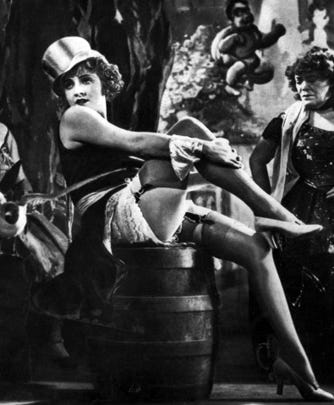
Friedrich Hollaender was the decade’s most gifted cabaret composer — a songwriter of extraordinary facility who could produce a melody that was simultaneously catchy and barbed, whose lyrics operated on multiple levels simultaneously. His song Berlin, dein Tänzer ist der Tod — Berlin, your dance partner is death — written in 1920 as the hyperinflation was gathering pace, managed to be both a dance tune and a prophecy in the same breath. He would later write Falling in Love Again for Marlene Dietrich in The Blue Angel — a film that captured the end of the Weimar era’s particular atmosphere with an accuracy that can only be achieved in retrospect.
Marlene Dietrich herself was a product of the Berlin cabaret circuit. Through the mid-twenties she worked the smaller stages, learning the craft of making a lyric land — the precise art of timing, of understatement, of the pause that is more expressive than the note. Her Berlin training is audible in everything she recorded for the next five decades: that quality of having seen everything and found it, on balance, somewhat amusing is a specifically Weimar Berlin quality, and it was the stages of the mid-twenties that produced it.
V. Kurt Weill, Bertolt Brecht, and the summit of August 1928
On the thirty-first of August 1928, the Theater am Schiffbauerdamm in Berlin staged the premiere of Die Dreigroschenoper — the Threepenny Opera — with music by Kurt Weill and a libretto by Bertolt Brecht. The audience included a substantial portion of Berlin’s intellectual and artistic establishment. By the time the curtain came down, it was clear that something had happened that was larger than a successful opening night.
The Threepenny Opera was, on its surface, an adaptation of John Gay’s eighteenth-century Beggar’s Opera, relocated to Victorian London and populated with criminals, prostitutes, and corrupt officials. Beneath that surface it was a precise and devastating analysis of the relationship between capitalism, crime, and respectability — an argument, made through song, that the distinction between a businessman and a gangster is largely a matter of which side of the law happens to be convenient at any given moment.
What Weill brought to this material was a musical language that was unlike anything that had been heard in a German theatre. He had absorbed jazz and American popular music, cabaret and Kurt Weill’s own classical training, and produced from these materials a sound that belonged to all of them and none of them — melodically direct, harmonically sophisticated, rhythmically propulsive in ways that owed everything to jazz and nothing to the German operatic tradition. The songs — Mack the Knife, the Alabama Song, the Ballad of Sexual Dependency — were designed to sound like things you had always known, folk songs from a country that had never existed.
Mack the Knife in particular deserves attention as a formal achievement. It is a song about a murderer that sounds like a nursery rhyme. The cheerfulness of the melody and the darkness of the content create a dissonance that is the Threepenny Opera’s central artistic strategy in miniature — the same dissonance that Weimar Berlin itself embodied, the same gap between the dancing on the surface and the violence underneath. Lotte Lenya, who played Jenny in the original production and recorded the songs throughout her career, understood this perfectly. Her voice on those recordings sounds like someone who has seen everything the song describes and has simply factored it into her understanding of how the world works.
For a musicologically trained ear — particularly one familiar with progressive rock’s exploration of similar territory forty years later — the Threepenny Opera is a revelatory document. Weill’s harmonic language anticipates developments in jazz and art rock that would not become widespread until the 1960s and 70s. The oblique relationship between melody and accompaniment, the use of unexpected chord changes under apparently simple tunes, the structural sophistication hidden beneath a deliberately accessible surface — these are precisely the techniques that Robert Fripp was exploring with King Crimson in 1969, and the lineage runs directly through the German musicians whom the Nazis drove into exile and who took their harmonic vocabulary to America, where it entered jazz and eventually rock.
VI. The geography of sound — where Berlin listened
The music of 1920s Berlin was not evenly distributed across the city. It had a geography, and understanding that geography is part of understanding what the music meant.
The grand dance halls — Clärchens Ballhaus in Mitte, the Haus Vaterland at Potsdamer Platz — were public and democratic in their way, accommodating thousands at a time, their orchestras playing to mixed crowds that crossed class lines on the dance floor if nowhere else. Clärchens Ballhaus, opened in 1913 and still operating today, is perhaps the most evocative surviving space from Weimar Berlin — its mirrored ballroom and painted ceilings unchanged, a physical remnant of what the decade felt like at its most openly joyful.
The basement Dielen of Schöneberg were something different — smaller, hotter, darker, and in some cases explicitly queer spaces where gay men and lesbians gathered with a visibility and relative safety that existed nowhere else in Europe at the time. The social freedoms of Weimar Berlin were not unlimited, but they were real, and the basement clubs of Schöneberg were where those freedoms were most fully expressed. The music played in these spaces was the same jazz and swing that played in the grand ballrooms, but its meaning was different — it was the soundtrack of a liberation that was fragile, provisional, and genuinely unprecedented.
The Romanisches Café on the Kurfürstendamm was not a music venue, but it was where the music business was conducted — where composers and lyricists, impresarios and performers, gathered to argue, negotiate, and plan. It was where Kurt Weill and Bertolt Brecht almost certainly discussed the Threepenny Opera over coffee. It was where the musical culture of Weimar Berlin had its intellectual home, in the same way that the dance halls were its physical one.
VII. What the music knew
The music of 1920s Berlin knew something that the politicians and the industrialists and the comfortable middle classes did not, or would not, allow themselves to know. It knew that the prosperity was borrowed, that the freedom was provisional, that the bruise underneath the dancing was real and would eventually be pressed hard enough to show.
This knowledge is not explicit in the music — you cannot point to a bar of Minor Swing or a chorus of Mack the Knifeand say: here is where the music knows what is coming. But it is present as a quality of attention, a sharpness that distinguishes Weimar music from the merely cheerful. The best of it — Weill’s songs, Waldoff’s cabaret numbers, the Comedian Harmonists at their most precisely comic — has an edge that comes from being made by people who understood, at some level, that the conditions that made it possible were not permanent.
When the Nazis came to power in 1933, they understood this too. The burning of books was a political act; the closing of the cabarets and the banning of jazz were cultural ones, aimed at the same target. They knew that the music of Weimar Berlin was not merely entertainment. It was a way of thinking about the world — irreverent, cosmopolitan, formally sophisticated, politically aware — that was incompatible with what they intended to build. They were right about that. The music and the regime it threatened could not coexist.
What they could not do was un-make the music. Grosz and Dix carried their paintings into exile. Lang and Murnau carried their visual language to Hollywood. Kurt Weill carried his harmonic vocabulary to Broadway and then to the world. The Comedian Harmonists scattered across three continents. And the music they had made in Berlin, in those borrowed, improbable, extraordinary years, went with them — changed by exile, shaped by new contexts, but fundamentally itself. The bruise was pressed. But the dancing had happened, and nothing that came after could reach back and take it away.
Sources & further reading
Weimar Culture: The Outsider as Insider — Peter Gay (1968). The essential introduction to the cultural life of the republic.
Kurt Weill: A Life — Ronald Sanders (1980). The most comprehensive English-language biography.
The Threepenny Opera — Bertolt Brecht / Kurt Weill (original libretto and score, available in English translation, Penguin Modern Classics).
Voluptuous Panic: The Erotic World of Weimar Berlin — Mel Gordon (2006). The most detailed account of the city’s nightlife and club culture.
Primary sources: Original Comedian Harmonists recordings (EMI Electrola archive) · Lotte Lenya’s recordings of the Weill/Brecht songs (Columbia Records, various dates).
© The European Century · europeancentury.substack.com
Companion content: The Listening Room playlist for this article — fifteen tracks tracing the arc of Weimar Berlin’s musical decade, with full annotations — is available to members of The European Century. Includes original recordings by the Comedian Harmonists, Claire Waldoff, Kurt Weill and Lotte Lenya, and the Quintette du Hot Club de France.
Tags: sound-of-the-streets · berlin · jazz · weimar-republic · 1920s · kurt-weill · cabaret · european-music · comedian-harmonists · marlene-dietrich